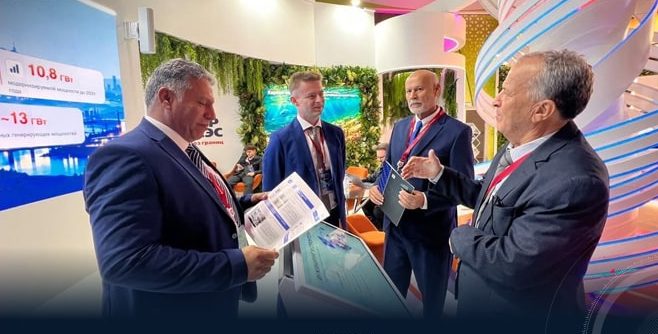


19 October 2026, London (The Energy Circle by IN-VR) - A delegation from Libya’s House of Representatives attended the 9th International Forum of Russian Energy Week, held in Moscow from 14 to 16 October 2026. The visit is part of a wider push to strengthen parliamentary and diplomatic relations between Libya and Russia, with the energy sector as its main focus.
The delegation was made up of Representatives Abdulnasser Al-Naas, Muftah Attia Al-Shaari and Muhammad Douma. House spokesperson Abdullah Bliheg announced their participation in a statement issued on Saturday. He said the visit aimed to draw on international experience in energy and economic policy, examine the challenges facing global energy markets, and explore avenues for cooperation between the two countries.
A Major Platform for Global Energy Dialogue
Russian Energy Week took place under the patronage of President Vladimir Putin. It is one of the main annual meeting points for policymakers, industry executives and experts from Russia and its international partners. This year’s edition included more than 30 panel discussions across seven thematic tracks, with over 100 speakers.
In his welcoming address on the opening day, President Putin called for wider international dialogue and cooperation in the fuel and energy sector. He placed particular emphasis on the security of shipping routes. He named three priorities for the forum’s agenda: the development of new energy sources, the shifts in oil and gas markets driven by geopolitical pressures, and the training of qualified professionals for the industry. Deputy Prime Minister Alexander Novak said discussions would also cover energy supply to the Arctic and remote areas, robotics, climate and environmental policy, and technological sovereignty in energy. He added that sessions would look at new sources of demand such as energy storage and data centres.
The wider programme focused on energy security, the stability of oil and gas markets, emerging technologies and promising projects. It also examined the economic and logistical shifts now reshaping global energy trade. For a producer like Libya, which depends heavily on oil exports and access to international markets, these questions bear directly on economic stability and long-term planning.
Parliamentary Diplomacy and the Energy Agenda
During the forum, the Libyan delegation highlighted the role of parliamentary diplomacy in developing relations with Moscow. The members called for wider economic and investment cooperation, particularly in energy, which they described as one of the cornerstones of the Libyan economy. They also stressed the importance of a more visible Libyan presence at international forums, and of partnerships built on mutual benefit.
Parliamentary diplomacy plays a supporting role next to the work of Libya’s executive authorities and the National Oil Corporation (NOC). Lawmakers do not negotiate contracts or award licences. They do, however, shape the legislative and political environment in which energy investment takes place. Direct contact with foreign governments and industry leaders can also help explain Libya’s priorities and build confidence among potential partners. No agreements were announced during the visit. Its significance lies in the dialogue it opens and the signal it sends about Libya’s willingness to engage widely.
Libya’s Production Momentum
The visit comes at a time of renewed momentum in Libya’s upstream sector. In June 2026, the NOC reported crude oil production of 1,438,560 barrels per day, plus 49,163 barrels per day of condensate. Combined output of about 1.48 million barrels per day was the highest level the country had recorded since 2013. NOC Chairman Masoud Suleiman called the figure a significant achievement and said the corporation aims to meet its planned production targets before the end of the year.
The longer-term goal is more ambitious. Libya aims to raise its production capacity to 2 million barrels per day by 2030. Reaching that level will require substantial investment in new exploration and in the rehabilitation of ageing fields, pipelines and export terminals, much of which suffered from years of underinvestment and repeated disruption. The NOC has repeatedly said that international partners, with their capital, technology and technical expertise, are essential to this effort.
Reopening the Upstream to Investment
An important step came in February 2026. The NOC announced the results of its first international licensing round in 17 years. The round offered 20 exploration blocks across the onshore Sirte and Murzuq basins and the offshore Sirte basin in the western Mediterranean. Five blocks were awarded:
- Eni and QatarEnergy secured offshore Block 01.
- A consortium of Repsol, TPAO and MOL won offshore Block 07.
- Repsol and TPAO secured a further award as a partnership.
- Chevron won the onshore Sirte S4 licence.
- Nigeria’s Aiteo took a block in the southern Murzuq basin.
The other blocks were left unawarded because of non-compliant technical bids or limited interest. The NOC introduced a new contractual model for the round, designed to give investors greater financial flexibility. It has said it will review the unsuccessful offers and may refine its terms for future rounds. Analysts have noted that political fragmentation and security concerns still add a risk premium to investment in Libya. This tends to favour companies with strong balance sheets or state backing. In that context, broad diplomatic engagement with a wide range of partners, including Russia, can help widen the pool of potential investors in future rounds.
Russia’s Long Presence in Libyan Energy
Russian companies have a long history in Libya’s energy sector. The most consistent is Tatneft, which has carried out exploration in the Ghadames Basin over many years, focusing on Block 4 of Area 82. Its activity has been intermittent since 2011, as instability repeatedly interrupted operations. The company returned to the block in 2021 to drill an appraisal well. In November 2022, the NOC announced that Tatneft had resumed exploration and moved a rig to the site to test another well.
This track record gives the current parliamentary engagement a practical foundation. Russian expertise in exploration, field development and gas technology is relevant to Libya’s needs. Its large energy companies are also familiar with operating in complex environments. At the same time, any expansion of cooperation will have to take into account the wider geopolitical context and the commercial and regulatory considerations that shape investment decisions in Libya.
A Broader Strategy of Engagement
The Moscow visit reflects a broader pattern. Libyan institutions are building relationships with a diverse range of partners across Europe, the Middle East, Asia, Africa and the Americas. The results of the 2026 licensing round brought together European, Gulf, Turkish, American and African companies. This shows the breadth of interest Libya can attract when conditions allow. Maintaining dialogue with as many partners as possible strengthens the country’s position as it competes for investment against other producers.
For the Libyan economy, the stakes are considerable. Hydrocarbons account for the vast majority of state revenue and export earnings. Sustained growth in production would support public finances, fund infrastructure and create space for economic diversification. Achieving that growth depends on stability, transparent and competitive terms, and continued engagement with the international energy community.
Looking Ahead
The House of Representatives’ participation in Russian Energy Week adds a parliamentary dimension to Libya’s energy diplomacy, alongside the work of the country’s executive authorities and the NOC. The visit produced no agreements, but it helps keep communication channels open with an established energy partner at a time of rapid change in global markets. Whether this dialogue turns into concrete commercial partnerships will become clearer in the coming months, as Libya pursues its production targets and prepares for future licensing opportunities.