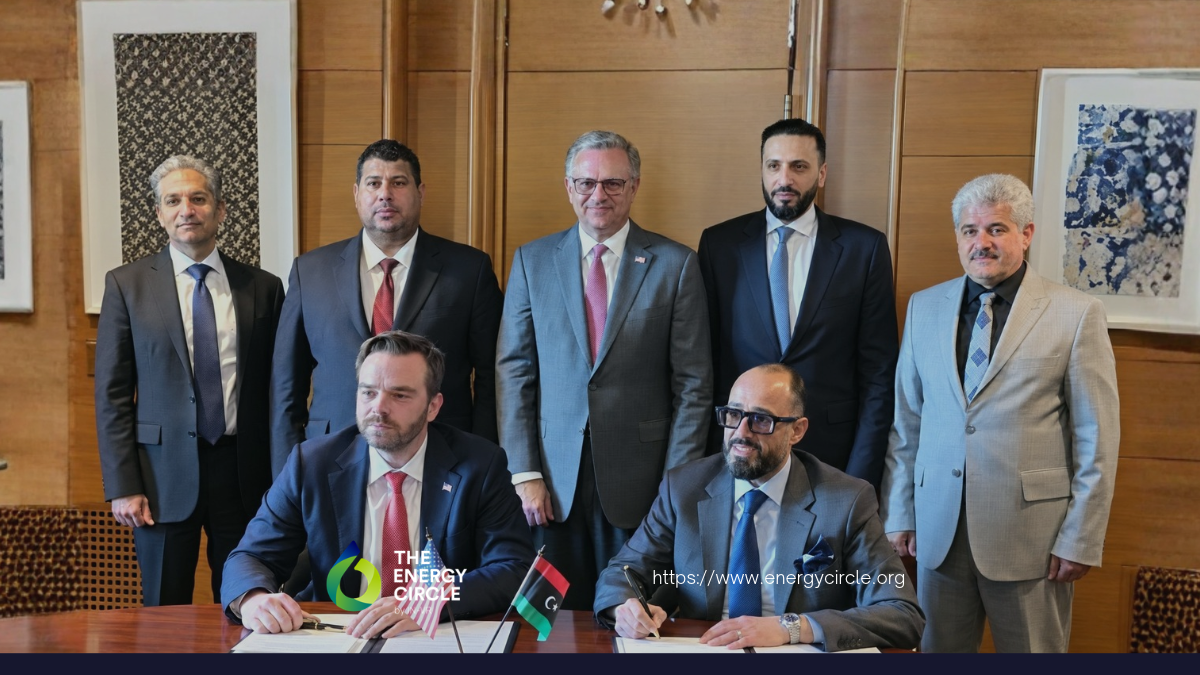
Libya and the United States have signed two memoranda of understanding (MoUs) covering civil aviation and strategic minerals in Washington, D.C., marking a new step in expanding economic and investment cooperation between the two countries.
The agreements were signed under the Executive Programme for the Strategic Partnership between Libya and the United States, which covers several key sectors, including oil and gas, mining, electricity, renewable energy, infrastructure, and technology.
The signing follows the launch of the strategic partnership programme and a series of bilateral meetings aimed at strengthening trade and investment ties and identifying opportunities for cooperation across key sectors of the Libyan economy.
The agreement with Boeing focuses on developing Libya’s civil aviation sector and advancing plans to establish a new national airline.
Key areas of cooperation include flight network planning, fleet development, training Libyan personnel, and establishing a specialized aircraft maintenance, repair, and overhaul (MRO) centre in line with international standards.
The agreements were signed by Mustafa Al-Mana, Head of the Executive Team for the Prime Minister’s Initiatives and Strategic Projects.
The signing ceremony was attended by Economy and Trade Minister Suhail Abu Shiha, National Oil Corporation Chairman Masoud Suleiman, Libyan Investment Authority Chairman Ali Mahmoud, U.S. Presidential Advisor for African and Middle Eastern Affairs Massad Boulos, and U.S. Department of Energy officials, alongside other Libyan and American representatives.
Boeing was represented by senior executives from its international operations, customer finance, and regional sales and marketing teams.
The second MoU covers cooperation in strategic minerals, reflecting the two countries’ interest in expanding collaboration in mining and economically important mineral resources.
The initiative forms part of a broader effort to develop investment opportunities in Libya’s mining sector, improve the use of its natural resources, and support technology transfer and national capacity building.
The two MoUs follow the launch of the Executive Programme for the Strategic Partnership between Libya and the United States in Washington, D.C.
The programme outlines several areas of cooperation, with a particular focus on the oil and gas sector, including increasing production and expanding exploration activities.
Other priorities include electricity and renewable energy projects, aviation and air transport development, mining and strategic minerals, infrastructure investment, technology transfer, and workforce development.
The programme also includes plans for high-level meetings with 21 U.S. government departments and institutions, alongside the signing of partnership agreements and the approval of implementation timelines for proposed projects.
As part of the broader partnership, the Libyan delegation also met with representatives of the Office of the U.S. Trade Representative (USTR) in Washington to discuss the work plan of the Libyan-U.S. Trade and Investment Council and follow up on the implementation of the Trade and Investment Framework Agreement (TIFA).
Discussions focused on addressing regulatory and customs barriers, facilitating the entry of American companies into the Libyan market, and identifying investment opportunities across energy, mining, infrastructure, and services.
Both sides also discussed coordination between relevant institutions and ways to translate existing agreements into practical measures and concrete trade and investment opportunities, including cooperation in digital services.
The expanding partnership could create new opportunities for Libya’s energy sector, particularly as oil and gas development remains one of the programme’s main priorities.
The potential impact can be seen across several areas:
For Libya, the partnership represents an opportunity to attract international expertise and investment, strengthen its energy infrastructure, and broaden the economic role of sectors beyond oil and gas.